Romaeuropa 2026: Three Dance Works, Three Ways of Being Present
OCTOBER 8, 2026 → WORDS ADRIÁN GOMIS EXPÓSITO
For more than four decades, Romaeuropa Festival has been one of Italy’s key platforms for contemporary performing arts. Now in its 41st edition, it brings international artists and new forms of theatre, dance, music and performance to Rome, setting established names beside emerging practices and turning the city itself into part of the experience.
Three dance works in this year’s programme stand out for how differently they approach the body: Rachid Ouramdane’s Lora, (LA)HORDE’s Après moi, le déluge and Boris Charmatz’s Muette. They differ radically in scale, language and aesthetic, yet each puts the physical body at the centre of the stage. Seen together, they read as three perspectives on presence: what it means to occupy a space, to be watched, to remember, to surrender and, finally, to move.

PHOTOGRAPHY COSIMO TRIMBOLI
Lora — Rachid Ouramdane
Lora tells the story of Lithuanian dancer Lora Juodkaitė and the movement practice she developed as a child: spinning again and again without losing her balance, a gesture that became both instinctive and consoling. Extracted from TORDRE, created in 2014 for two dancers, the solo trades spoken testimony for movement itself, probing the point where a gesture turns both poetic and therapeutic.
At Villa Medici, the setting becomes part of the work’s language. The permanence of the location sets off the vulnerability of a single body, in a piece built on repetition, control and the possibility of losing both.

PHOTOGRAPHY COSIMO TRIMBOLI
The spinning initially seems almost abstract. Gradually, repetition gains emotional weight, and what begins as restrained and intimate grows into isolation, rage and power. The movement repeats but is never identical; each turn seems to carry the memory and the exhaustion of the one before. Juodkaitė keeps her balance even with her eyes closed, which suggests extraordinary discipline, yet the intensity of the spinning constantly threatens to overwhelm it. The body is at once the instrument and the subject of the performance.
The piece grows more personal when Juodkaitė reveals that the habit began in childhood as a private comfort, and that it could turn into a source of shame when others saw it. On stage, she reclaims it as expression. Lora is therefore about more than movement: it is about what happens when something once hidden is brought into public view, and vulnerability becomes strength. Its most affecting quality lies in that tension, a body entirely in control that never lets us forget how close control is to collapse.

PHOTOGRAPHY COSIMO TRIMBOLI
Après moi, le déluge — (LA)HORDE, Ballet National de Marseille
If Lora follows the transformation of one body, (LA)HORDE’s Après moi, le déluge expands that physical language into something collective, unstable and cinematic. Conceived as a movement against the flow of time, it imagines a return to the moment before catastrophe and confronts the monstrous figures, silences and gestures of surrender that populate our collective narratives.
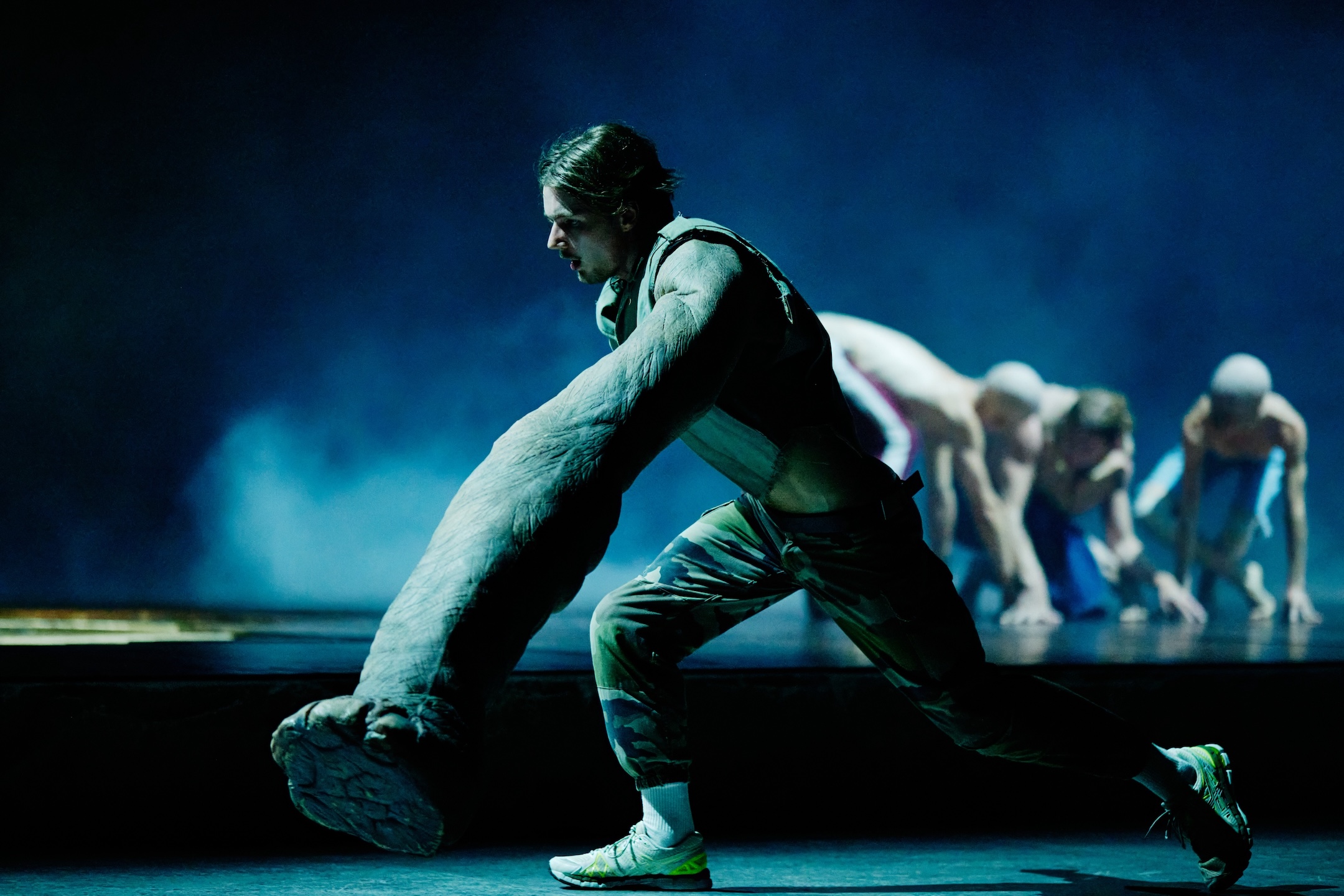
The performance begins before it officially begins. Behind a veil, the dancers move slowly, almost mechanically, like bodies suspended between human and artificial. From there, the work keeps mutating: the stage tilts, opens and changes function, while live action and projected images compete for attention.


PHOTOGRAPHY PIERRE GONDARD
That tension between the physical and the filmed is one of its most compelling ideas. The camera does not simply document the dancers; it produces another version of reality, magnifying faces, gestures and fragments of movement while the audience negotiates between what the lens captures and what escapes its frame.
The stage eventually seems to collapse and regenerate. Water, smoke, masks and animal-like figures bring an almost apocalyptic imagery, before the atmosphere shifts again towards something more energetic and physical. The transitions can feel deliberately excessive, but excess is central to the logic of a work less interested in linear narrative than in a world of perpetual instability. What emerges is a choreography of collapse and reconstruction, in which transformation is not an interruption but a condition of existence.

PHOTOGRAPHY LAURENT PHILIPPE

PHOTOGRAPHY FABIAN HAMMERL
Muette — Boris Charmatz
Muette moves towards a more stripped-back form of expression. This solo treats silence not as the absence of sound but as a space where the body can say what words cannot. Conceived as a continuation of Charmatz’s earlier SOMNOLE, it follows a cry that never quite emerges, a body that absorbs and resists without speaking.

PHOTOGRAPHY CÉSAR VAYSSIÉ
Performed at Mattatoio, a former slaughterhouse turned cultural space, the work finds a fitting starkness. Little stands between performer and audience: Charmatz’s naked body, moving through silence, is both subject and language. Sweat, saliva, exhaustion and stillness are part of the choreography, making the physical effort impossible to ignore.
Nudity here changes the act of looking. Rather than simply exposing the body, it makes the audience aware of its own gaze, and without dialogue or conventional narrative, attention narrows to the smallest gestures and shifts in the body.

PHOTOGRAPHY LAURENT PHILIPPE
Like Lora, Muette finds meaning in vulnerability, but where Juodkaitė pushes repetition towards intensity and release, Charmatz works through restraint. Even the black heart painted on his skin slowly dissolves beneath sweat, leaving the image of something expressed, endured and finally absorbed. The body, Muette suggests, does not need to be loud to be heard.

PHOTOGRAPHY COSIMO TRIMBOLI
Final Thoughts: A Physical Language
Lora finds vulnerability in repetition, Muette finds expression in silence and exposure, and Après moi, le déluge turns the individual body into something collective and unstable. What binds them is not a shared aesthetic but a conviction that performance is a physical language capable of communicating beyond words.
Personally, I arrived at Lora sceptical and left moved: it was strong, beautiful and, at its most intense, breathtaking. Après moi, le déluge was the most impactful of the three, a multidimensional spectacle that kept me hooked from the first slow-moving mannequin to the last animal-like figure. Muette was the most unsettling: intimate, at times uncomfortable, but above all pure, and it stirred more conflicting emotions in me than either of the others.
Dance is only one strand of a programme that also spans theatre, music and visual arts. Yet it shows the festival at its most direct: artists and audiences in the same physical space, in encounters that cannot be reduced to a screen, an image or an explanation. Across these three works, the body becomes a way of asking how we occupy space, how we look at one another and how performance can make us pay attention.
That feels especially urgent in a culture saturated with images and ceaseless digital motion. Contemporary dance asks for something else: time, attention and a willingness to stay present without being handed an answer. You may leave without a definitive interpretation, but you leave having experienced something. That may be Romaeuropa’s greatest strength: not just presenting contemporary art, but creating the conditions in which audiences can encounter it.
Romaeuropa 2026: Three Dance Works, Three Ways of Being Present
OCTOBER 8, 2026
WORDS ADRIÁN GOMIS EXPÓSITO
For more than four decades, Romaeuropa Festival has been one of Italy’s key platforms for contemporary performing arts. Now in its 41st edition, it brings international artists and new forms of theatre, dance, music and performance to Rome, setting established names beside emerging practices and turning the city itself into part of the experience.
Three dance works in this year’s programme stand out for how differently they approach the body: Rachid Ouramdane’s Lora, (LA)HORDE’s Après moi, le déluge and Boris Charmatz’s Muette. They differ radically in scale, language and aesthetic, yet each puts the physical body at the centre of the stage. Seen together, they read as three perspectives on presence: what it means to occupy a space, to be watched, to remember, to surrender and, finally, to move.

PHOTOGRAPHY COSIMO TRIMBOLI
Lora — Rachid Ouramdane
Lora tells the story of Lithuanian dancer Lora Juodkaitė and the movement practice she developed as a child: spinning again and again without losing her balance, a gesture that became both instinctive and consoling. Extracted from TORDRE, created in 2014 for two dancers, the solo trades spoken testimony for movement itself, probing the point where a gesture turns both poetic and therapeutic.
At Villa Medici, the setting becomes part of the work’s language. The permanence of the location sets off the vulnerability of a single body, in a piece built on repetition, control and the possibility of losing both.

PHOTOGRAPHY COSIMO TRIMBOLI
The spinning initially seems almost abstract. Gradually, repetition gains emotional weight, and what begins as restrained and intimate grows into isolation, rage and power. The movement repeats but is never identical; each turn seems to carry the memory and the exhaustion of the one before. Juodkaitė keeps her balance even with her eyes closed, which suggests extraordinary discipline, yet the intensity of the spinning constantly threatens to overwhelm it. The body is at once the instrument and the subject of the performance.
The piece grows more personal when Juodkaitė reveals that the habit began in childhood as a private comfort, and that it could turn into a source of shame when others saw it. On stage, she reclaims it as expression. Lora is therefore about more than movement: it is about what happens when something once hidden is brought into public view, and vulnerability becomes strength. Its most affecting quality lies in that tension, a body entirely in control that never lets us forget how close control is to collapse.

PHOTOGRAPHY COSIMO TRIMBOLI
Après moi, le déluge — (LA)HORDE, Ballet National de Marseille
If Lora follows the transformation of one body, (LA)HORDE’s Après moi, le déluge expands that physical language into something collective, unstable and cinematic. Conceived as a movement against the flow of time, it imagines a return to the moment before catastrophe and confronts the monstrous figures, silences and gestures of surrender that populate our collective narratives.
The performance begins before it officially begins. Behind a veil, the dancers move slowly, almost mechanically, like bodies suspended between human and artificial. From there, the work keeps mutating: the stage tilts, opens and changes function, while live action and projected images compete for attention.


PHOTOGRAPHY PIERRE GONDARD
That tension between the physical and the filmed is one of its most compelling ideas. The camera does not simply document the dancers; it produces another version of reality, magnifying faces, gestures and fragments of movement while the audience negotiates between what the lens captures and what escapes its frame.
The stage eventually seems to collapse and regenerate. Water, smoke, masks and animal-like figures bring an almost apocalyptic imagery, before the atmosphere shifts again towards something more energetic and physical. The transitions can feel deliberately excessive, but excess is central to the logic of a work less interested in linear narrative than in a world of perpetual instability. What emerges is a choreography of collapse and reconstruction, in which transformation is not an interruption but a condition of existence.

PHOTOGRAPHY LAURENT PHILIPPE

PHOTOGRAPHY FABIAN HAMMERL
Muette — Boris Charmatz
Muette moves towards a more stripped-back form of expression. This solo treats silence not as the absence of sound but as a space where the body can say what words cannot. Conceived as a continuation of Charmatz’s earlier SOMNOLE, it follows a cry that never quite emerges, a body that absorbs and resists without speaking.

PHOTOGRAPHY CÉSAR VAYSSIÉ
Performed at Mattatoio, a former slaughterhouse turned cultural space, the work finds a fitting starkness. Little stands between performer and audience: Charmatz’s naked body, moving through silence, is both subject and language. Sweat, saliva, exhaustion and stillness are part of the choreography, making the physical effort impossible to ignore.
Nudity here changes the act of looking. Rather than simply exposing the body, it makes the audience aware of its own gaze, and without dialogue or conventional narrative, attention narrows to the smallest gestures and shifts in the body.

PHOTOGRAPHY LAURENT PHILIPPE
Like Lora, Muette finds meaning in vulnerability, but where Juodkaitė pushes repetition towards intensity and release, Charmatz works through restraint. Even the black heart painted on his skin slowly dissolves beneath sweat, leaving the image of something expressed, endured and finally absorbed. The body, Muette suggests, does not need to be loud to be heard.

PHOTOGRAPHY COSIMO TRIMBOLI
Final Thoughts: A Physical Language
Lora finds vulnerability in repetition, Muette finds expression in silence and exposure, and Après moi, le déluge turns the individual body into something collective and unstable. What binds them is not a shared aesthetic but a conviction that performance is a physical language capable of communicating beyond words.
Personally, I arrived at Lora sceptical and left moved: it was strong, beautiful and, at its most intense, breathtaking. Après moi, le déluge was the most impactful of the three, a multidimensional spectacle that kept me hooked from the first slow-moving mannequin to the last animal-like figure. Muette was the most unsettling: intimate, at times uncomfortable, but above all pure, and it stirred more conflicting emotions in me than either of the others.
Dance is only one strand of a programme that also spans theatre, music and visual arts. Yet it shows the festival at its most direct: artists and audiences in the same physical space, in encounters that cannot be reduced to a screen, an image or an explanation. Across these three works, the body becomes a way of asking how we occupy space, how we look at one another and how performance can make us pay attention.
That feels especially urgent in a culture saturated with images and ceaseless digital motion. Contemporary dance asks for something else: time, attention and a willingness to stay present without being handed an answer. You may leave without a definitive interpretation, but you leave having experienced something. That may be Romaeuropa’s greatest strength: not just presenting contemporary art, but creating the conditions in which audiences can encounter it.